
AI Productivity and the Dark Side of Efficiency
Go on, use AI, you’ll have more time to focus on other things. AI tools were supposed to make our jobs less stressful. But somewhere between the endless prompts, the instant outputs, and the expectation that you can now do the work of five people, something has broken. In February 2026 an article was published in the Harvard Business Review about a paradox happening in AI. Something that every developer working with AI has experienced. Most of the time they push through with some moans and grumbles to their teammates. Before you roll your eyes and sigh “oh not another data centre/AI-companies-are-evil/save-the-environment/LLMS-are-just-really-fancy-autocorrect article”; the HBR article was called AI Doesn’t Reduce Work — It Intensifies It.
The article discusses research findings from a study. Over 8 months the study followed the experiences of 200 workers in 1 tech company as they used Generative AI tools. Not gigantic numbers but don’t let that stop you reading more.
The study identified ways in which the employees’ work intensified.
1) Scope creep
Gen AI was so helpful that workers began taking on duties outside of their usual roles. PMs started coding, researchers handled development work. This had knock-on effects, such as engineers suddenly having an extra workload because everyone and their uncle thought they could vibe-code some Production-level software.
People that shouldn’t be creating production-grade code can now do that. This issue isn’t hard to fix. In fact, the study gave some recommendations. I’ll go through them at the end of the article.
In my personal experience using Gen AI tools for coding; they can fix bugs, write documentation, follow a structure, write some crazy Automated Tests (playwright-cli, anyone), write and push commits. But I’ve never been able to let a Gen AI tool run amok in some code. There have always been things I’ve had to jump in and fix manually. Even a simple bash script can become bloated and tangled without a well structured prompt.
2) Work-Life Balance
Anyone who has used Generative AI tools for knowledge work knows how it can suck you in. The early part of the task is usually pretty effortless and so you make good progress. You tell people about how you’re making good progress. You vibe-code a demo app which goes down well. It encourages you to squeeze more and more in and this eats into lunch breaks or after-hours work. Then a few more prototypes into the task you discover a huge list of potential blockers and there is the realisation that you’ve bitten off more than you can chew. And then your project gets fast-tracked with some tight deadlines. And then you have the other problem of needing to support a feature that no customer asked for but it’s destined for Production anyway.
3) More Tasks, More Problems
Employees were given more tasks because the assumption from management was that “AI is helping, so of course you can do more things”. The study found that employees ran several processes at once; they were manually coding, as well as using AI-generated solutions and keeping multiple tasks active in parallel. There was improved progress using Gen AI, yet for the person doing the work it meant more time switching focus and increasing their cognitive load.
Another study by the London School of Economics found that companies viewed using AI as a way to have a 7.5 hour “productivity gain”, basically saving one work day per week. It was assumed that employees would work fewer hours, but what actually seems to be happening is that they are expected to do more with the time they saved.
4) Mental autopilot
At the start of a project, there are lots of little tasks that need to be done. These tasks are great for 2 reasons. One; you don’t have to think too much about them. Two; it gives your subconscious brain time to analyse the tasks some more and think of other approaches and solutions. Using Gen AI tools straight away reduces this initial thinking period. People would jump straight into a task. In the study it made people feel more reliant on AI to deliver. It sped up the tasks, and increased expectations whilst also reducing their thinking power.
The “2 commits and a README” phenomenon
Some might say that this all sounds like “a you” problem. It sort of is and sort of isn’t. With a lot of experience, coding using a Generative AI tool has a learning curve. For most software engineers that are not extremely experienced developers, it’s an inverted curve. They hit a scalability wall. They want to do more. They know how to do more. But the “2 commits and a README” phenomenon is real. Github is a graveyard of abandoned side projects. Developers can just now create and abandon them at a quicker rate. They can do more, think less. Burnout quicker.
Software Engineering is full of tongue-in-cheek, catchy proverbs which seem like a joke but are also actually true
- Anything that can be written in Javascript will eventually be written in Javascript,
- the two hardest things in computer science are cache invalidation, naming things and off by one errors,
- the Scream Test,
- Rubber Duck Programming,
- Works On My Machine,
- and this awesome rule called the 90/90 Rule, still as relevant today as when it was first uttered back in 1985 by a Bell Labs employee Tom Cargill. The quote is below.
90/90 Rule: The first 90 percent of the code accounts for the first 90 percent of the development time. The remaining 10 percent of the code accounts for the other 90 percent of the development time.
A solution
By eliminating creative blocks and making it easier to start tasks, these tools remove natural pauses in the workday. These tools also made people feel like they have a companion. But that seems to add a false sense of security. It could lead to a wave of “AI Burnout” and lower quality of work.
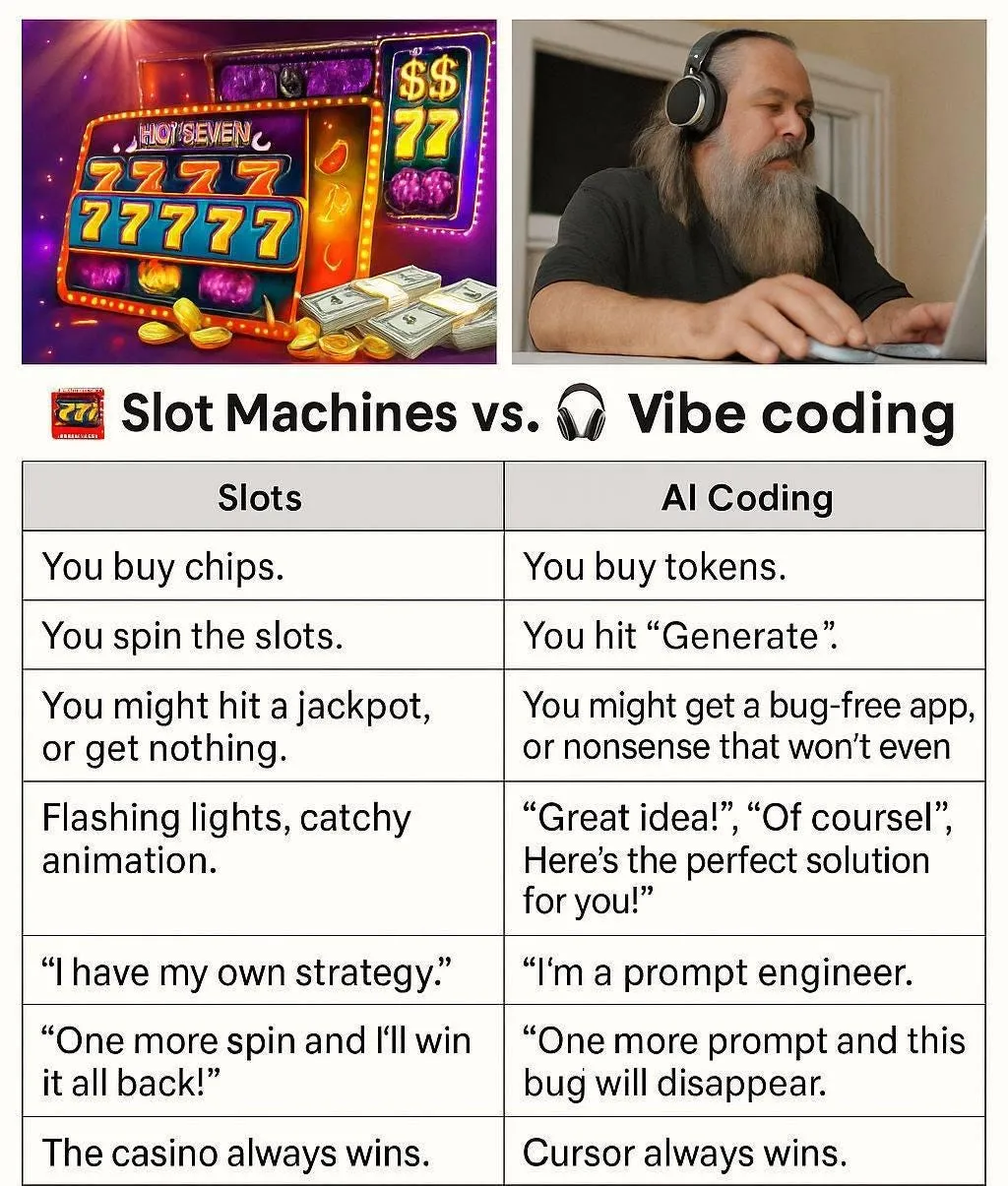
Gen AI tools make it easier to do more. People being people, they will usually choose to do something more if the barrier to entry is low. It’s why people get baited by the seductive charms of AWS. It reminds me of this meme (image below) about gambling vs vibe coding. Most memes are rooted in truth, and are pithy takes on the real-world. Addictive, flashy, the “feeling” of progress but the confusion of “what did I do in the last 3 hours”. No, not doom scrolling or playing slot machines. You were vibe coding.
Anyway, back to the solution. The AI Doesn’t Reduce Work — It Intensifies It article ended with some pretty under-whelming, obvious solutions.
Organisations and managers need to understand that using Generative AI tools can lead to work informally expanding. Telling employees to take care of their mental health while using Generative AI for their work is not the solution. Instead of it reshaping an organisation, they need to actively shape how they use AI. They need to build in an intentional way that AI is used, in the article, this is called “AI Practice”. Which is a fancy way of saying that there needs to be some standards set by the organisation on how they sustainably use Gen AI tools. This means things like adding intentional, structured pauses. Moments of downtime to prevent overload accumulation. They also recommend something called “sequencing” which aims to protect focus windows and reduce cognitive load.
My take on this is that many software development professionals will already recognise signs of burnout in themselves. They will realise that they are being pushed unsustainably to do more in less time. They will know they’re working longer unproductive hours. They are smart enough to take action, somehow. But some of the less experienced software developers won’t know that, they might not even realise that burnout is a thing. And that’s concerning. This means that it’s up to organisations and managers to set the guardrails for how these tools can be used in a healthy, sustainable way.
And I’ve not even mentioned “data centres/AI-companies-are-evil/save-the-environment/LLMS-are-just-really-fancy-autocorrect” yet.